
The Matriarch: What Orcas Know About Midlife That We Forgot
Jul 10, 2026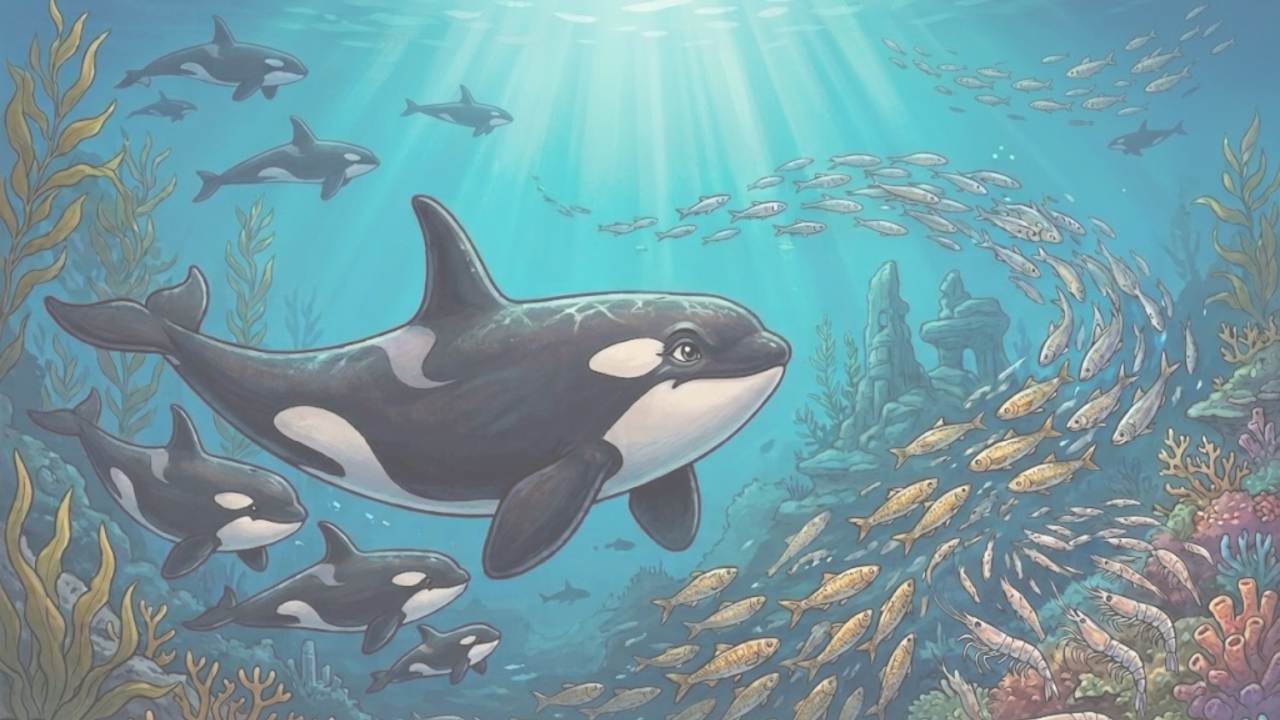
Female orcas are one of only a handful of animals known to live long past their fertile years. What they do with that time reframes the story many of us have inherited about perimenopause, menopause, midlife and decline.
Most of us absorbed a story about menopause without ever being taught it directly. The fertile years are the important ones, it says. What follows is a slow fade – a winding down, a becoming-less, and useless. It's a tidy story. It's also not correct.
Do orcas go through menopause?
Yes. Female orcas, or killer whales, are one of the few non-human animals known to experience menopause and live for decades afterwards. Menopause is rare in nature: in most species, females reproduce until close to the end of life. But in humans and several toothed whales – including orcas, short-finned pilot whales, belugas, narwhals and false killer whales – females can live for many years after reproduction ends.
The interesting part isn't simply that they stop reproducing. It's what they do next.
Why do orcas live so long after menopause?
One leading explanation is that older females hold value that has nothing to do with producing more offspring. In evolutionary biology, this is often discussed through the Grandmother Hypothesis: the idea that older females can increase the survival of their family group by sharing food, care and knowledge. In species such as humans and killer whales, helping the next generation may contribute more to survival than continuing to reproduce.
In orca pods, post-reproductive females don't drift to the edges. They move to the centre. They become the ones who lead – the keepers of decades of ecological knowledge about where to find food when a season turns lean, which routes to take, and what the pod needs to get through a hard year. Researchers studying resident killer whales found that in the years when salmon were scarce, it was the older, post-reproductive females who were most likely to lead the group to the foraging grounds. Their reproductive role had changed; their contribution to the pod appears to have increased.
The same research points to something even starker: when an older mother dies, her adult offspring – particularly her sons – become far more likely to die in the year that follows. Her knowledge, it turns out, is load-bearing.
A different story about the same event
This is a very different account of menopause than the one many women in Western cultures inherit. The dominant narrative often frames midlife and perimenopause as a sequence of losses: fertility, capacity, desirability, relevance. And it's worth being honest that parts of this transition can be hard. Sleep frays. Words go missing mid-sentence. The body does things it did not ask permission to do. Emotions may arrive larger than expected, and some women experience symptoms that are disruptive, distressing or life-altering. Read more on why you think you might be losing your mind. None of that is imaginary, and none of it deserves to be waved away with a motivational poster.
But the orcas fill in what the loss story leaves out: what looks like an ending from the outside may also be a shift into a role the group cannot afford to lose. The difficulty and the expansion are not taking turns – they occupy the same stretch of time.
Why this isn't just a nice metaphor
It would be easy to file the orca story under inspiring animal facts and move on, but it does more than comfort. The way we frame a transition shapes how we move through it, and this isn't wishful thinking. In one long-running study, people who held more positive beliefs about ageing went on to live around seven and a half years longer than those who held more negative beliefs – a gap that remained even after factors such as age, gender, socioeconomic status, loneliness and functional health were accounted for.
Our expectations colour how we read what happens inside an experience. If you believe midlife is decline, a foggy morning becomes evidence of that decline. If you understand the same stretch as a transition – hard in places, disruptive in places, and also a doorway into something with more range rather than less – the foggy morning reads differently. Still annoying, but not proof that you are disappearing.
The midlife brain is changing, not simply declining
The neuroscientist Lisa Mosconi describes the menopausal transition not as a brain breaking down, but as a period of neurological reorganisation as the brain adapts to changing hormone levels. That doesn't mean every change feels good; it means the story is more complex than decline. Research on cognition in midlife women does show some changes, including slower processing speed and subtle shifts in aspects of memory over time – anyone who has stood in the pantry wondering what they came in for does not need a journal article to know that something can feel different.
But that is not the whole picture. Other capacities – including accumulated knowledge, pattern recognition, judgement and emotional regulation – often remain stable or strengthen with age and experience, and this holds for adults in general, not only for women. Recent research tracking dozens of psychological traits across the lifespan found that overall functioning tends to peak in late midlife rather than early adulthood. Midlife brains may not always be the fastest in the room; they may, however, be better at seeing the room.
The orcas suggest the same at the scale of a whole life. What arrives on the far side of the fertile years is not a diminished thing; in the species that live long enough to find out, it may be the thing the group most relies on.
What the matriarch actually does
The elder orca's role is not passive. She is not respected because she has simply survived; she is central because she knows things, and because she puts what she knows to work for the pod. That is the part that asks something of us. The invitation of midlife is not to wait around to be respected for getting older – it is to take the accumulated knowledge of a life lived, the pattern recognition, the hard-won judgement, the clearer sense of what matters that you did not have at thirty, and decide what to build with it. Wisdom is not simply something we accumulate with age; like the elder orca, its value comes from putting it to work.
That is a creative act, and a forward-looking one, and it is available now – in the middle of the difficulty, not only once the difficulty clears. You have spent decades gathering the wisdom. The question midlife puts to you is not whether you still matter; it is what you will do with everything you have learned.
Frequently asked questions
Do any animals besides humans go through menopause?
Yes, though very few. Menopause and a long post-reproductive lifespan are well documented in humans and several toothed whales, including orcas, short-finned pilot whales, belugas, narwhals and false killer whales. Most animals reproduce until close to the end of life, which is part of what makes the human and orca pattern so scientifically interesting.
Why do orcas go through menopause?
Scientists think menopause may have evolved in orcas because older females help their family groups survive. Post-reproductive female orcas carry ecological knowledge about food sources, travel routes and environmental conditions. This knowledge appears to be especially important in difficult years, such as when salmon are scarce.
What is the Grandmother Hypothesis?
The Grandmother Hypothesis suggests that menopause may have evolved because older females can improve the survival of their children and grandchildren. Rather than continuing to have more offspring themselves, they contribute through care, food-sharing, leadership and knowledge transfer.
Is midlife a time of decline?
Not in the simple way the common story suggests. The perimenopausal transition can bring real symptoms, including sleep disruption, hot flushes, mood changes and brain fog. Some cognitive functions, such as processing speed, can shift in midlife. But permanent diminishment is not the whole story: accumulated knowledge, judgement, perspective and emotional regulation can remain strong or deepen with age and experience.
Can changing how I think about menopause actually make a difference?
How we frame an experience can shape how we interpret and respond to it. Reframing does not erase symptoms, and it is not a substitute for medical care where that is needed. But understanding this stage as a transition rather than a collapse can change how we read what is happening – and that shift is worth having.
The Midlife Reframe is an 8-day, 15 minutes per day, online program for women navigating the psychological and identity shifts of midlife and perimenopause. Across eight short days, we explore the psychology of this transition – from the neuroscience of brain renovation to values, strengths, joy and creating a vision for what comes next. If you want to see how equipped you currently feel for navigating the perimenopausal transition, take your Midlife Pulse here.
These articles are educational, not therapeutic. If you are concerned about any symptoms – physical, cognitive or emotional – please speak with your GP or a mental health professional.
References
Brent, L. J. N., Franks, D. W., Foster, E. A., Balcomb, K. C., Cant, M. A., & Croft, D. P. (2015). Ecological knowledge, leadership, and the evolution of menopause in killer whales. Current Biology, 25(6), 746–750. https://doi.org/10.1016/j.cub.2015.01.037
Ellis, S., Franks, D. W., Nielsen, M. L. K., Weiss, M. N., & Croft, D. P. (2024). The evolution of menopause in toothed whales. Nature, 627, 579–585. https://doi.org/10.1038/s41586-024-07159-9
Foster, E. A., Franks, D. W., Mazzi, S., Darden, S. K., Balcomb, K. C., Ford, J. K. B., & Croft, D. P. (2012). Adaptive prolonged postreproductive life span in killer whales. Science, 337(6100), 1313. https://doi.org/10.1126/science.1224198
Gignac, G. E., & Zajenkowski, M. (2025). Humans peak in midlife: A combined cognitive and personality trait perspective. Intelligence, 113, 101961. https://doi.org/10.1016/j.intell.2025.101961
Karlamangla, A. S., Lachman, M. E., Han, W., Huang, M., & Greendale, G. A. (2017). Evidence for cognitive aging in midlife women: Study of Women's Health Across the Nation. PLOS ONE, 12(1), e0169008. https://doi.org/10.1371/journal.pone.0169008
Levy, B. R., Slade, M. D., Kunkel, S. R., & Kasl, S. V. (2002). Longevity increased by positive self-perceptions of aging. Journal of Personality and Social Psychology, 83(2), 261–270. https://doi.org/10.1037/0022-3514.83.2.261
Mosconi, L., Berti, V., Dyke, J., Schelbaum, E., Jett, S., Loughlin, L., Jang, G., Rahman, A., Hristov, H., Pahlajani, S., Andrews, R., Matthews, D., Etingin, O., Ganzer, C., de Leon, M., Isaacson, R., & Brinton, R. D. (2021). Menopause impacts human brain structure, connectivity, energy metabolism, and amyloid-beta deposition. Scientific Reports, 11, 10867. https://doi.org/10.1038/s41598-021-90084-y