
Why change feels harder before it gets easier
Apr 15, 2026
There’s a particular kind of discouragement that arrives when you’re trying to change something and it seems to get worse, not better.
Let's say you’ve done the hard work of identifying something you'd like to change in your life. Perhaps you want a more equitable split of household duties, or firmer boundaries at work so you can actually be present with your family when you get home. You made the decision. You planned it. You started.
And then, seemingly out of nowhere, the very thing you’re trying to change intensifies, as if everything is conspiring to restore the status quo. The old pattern surges back with a force that makes you wonder whether you were deluding yourself from the start. You may give up, or feel like giving up, convinced that it just isn’t going to work.
But, this pushback doesn’t necessarily signal failure and it isn’t necessarily a sign that the change isn’t working.
Or… consider another scenario.
Change may have arrived without your choosing it. A partner unexpectedly stops doing something they’ve always done (perhaps managing the household diary or handling the finances). An adult child abruptly stops coming for weekly dinners. A colleague stops answering calls after hours. You’re left feeling confused, and, without quite realising it, you find yourself pushing harder to get things back to the way they were.
This increase in behaviour in response to change, is a well-studied behavioural mechanism. Once you recognise it and can name it, it changes how you interpret and respond to what’s happening, whether you’re the one initiating change or the one being impacted by it.
What is an extinction burst?
The term comes from behavioural science.
It describes what sometimes happens when a behaviour that has been consistently reinforced suddenly stops receiving that reinforcement. Put very simply:
- Behaviours that are rewarded tend to increase.
- Behaviours that stop being rewarded tend to decrease.
- But in between, in that gap, things often get worse before they get better.
This pattern often looks something like this:
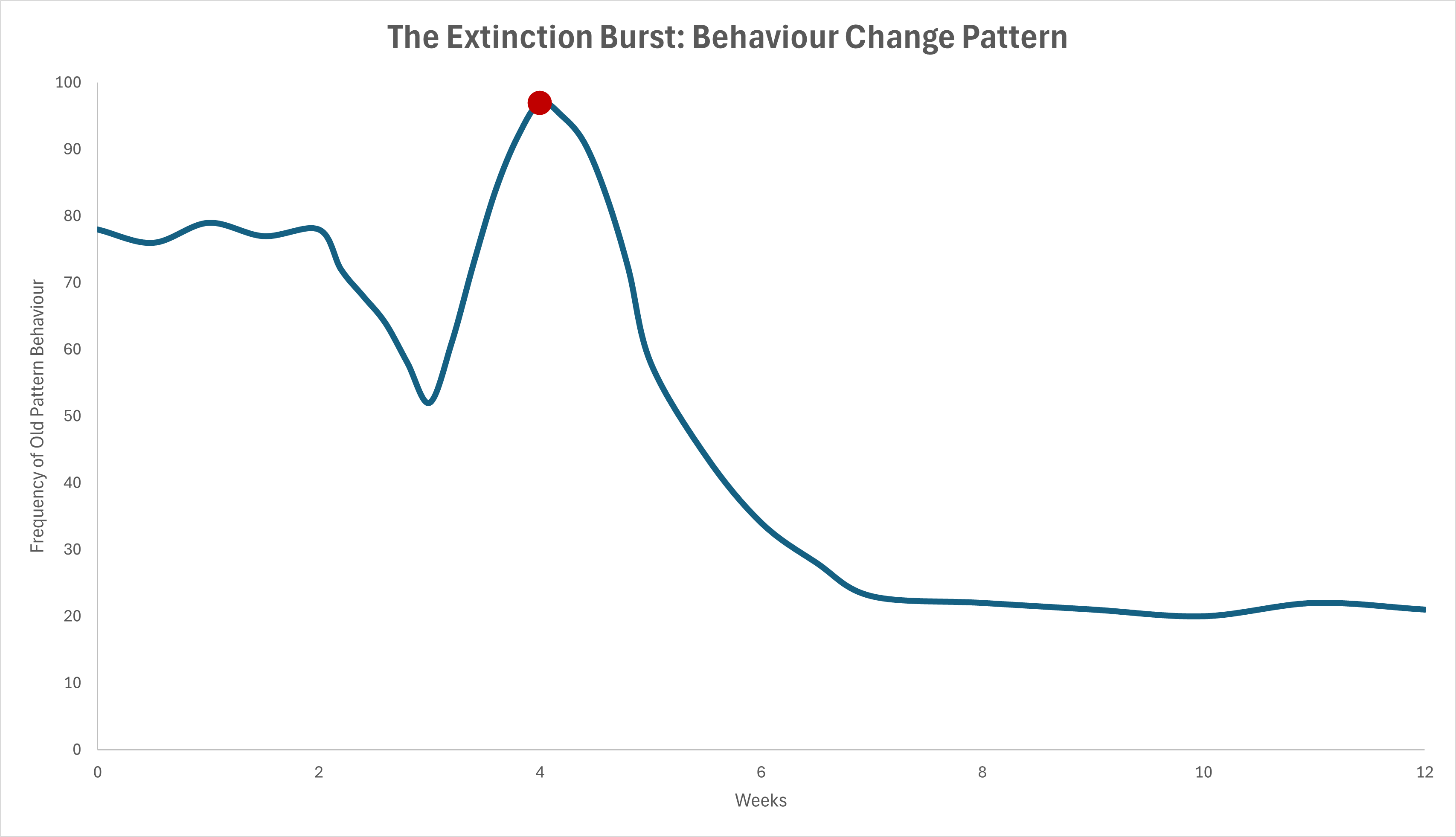
A period of change, a spike (the burst), then a gradual settling.
Here’s an example most parents / aunts / uncles etc will recognise. Think of taking a young child to the supermarket. Clever marketers have placed sweets at the checkout. The child picks up a lollipop and refuses to put it down. You insist. The child has the mother of all tantrums. You're tired, embarrassed, in a hurry - and you think: just this once. In doing so you've accidentally reinforced the behaviour. He now knows that tantrums get lollipops.
To break that pattern, you'd need to hold the line. Every. Single. Time. And, when you do: the tantrums may increase in frequency, duration, and well… volume before they stop. Much louder! You may think ‘this isn't working’ and you give in, which starts the cycle again.
But what you were experiencing may have been an extinction burst. Had you held long enough, the behaviour would probably have extinguished. Not immediately and almost certainly not comfortably but actually extinguished.
This pattern doesn't occur in every case. But it happens often enough. Strictly speaking, this concept comes from controlled behavioural research settings, but we see a very similar pattern play out across adult life: in habits, in relationships, and in the roles we've been reinforced for over time. The critical thing to understand:
- When things get louder, it doesn’t automatically mean the change isn’t working.
- It may mean the old pattern is still doing what it has always done.
What it looks like in real life
When you’re the one making the change
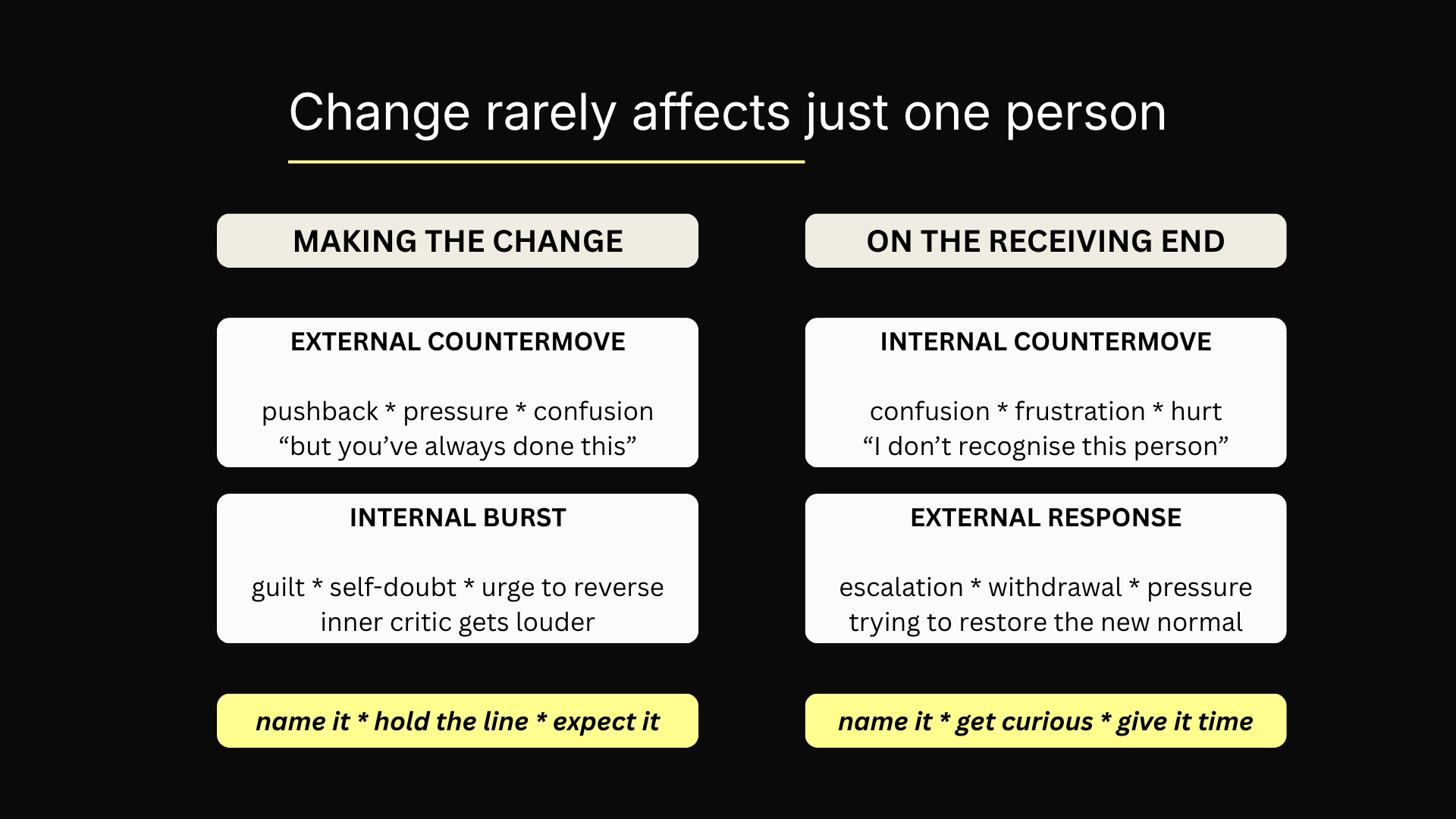
The extinction burst shows up in almost every meaningful change, and so does what Harriet Lerner calls the countermove in her classic book, The Dance of Anger: the way people around us respond to our change by trying, usually unconsciously, to pull us back into the old pattern.
Take someone who has spent years being the dependable one at work - taking extra tasks, staying late, rarely saying no. Rewarded for it. Recognised for it. It's become their role and identity.
When they start to change that pattern by setting limits, declining extra work, stopping the over-explaining, two things happen almost immediately:
Externally, the system resists.
Colleagues push harder. A manager raises an eyebrow. People who've relied on the old pattern respond with confusion, frustration, or pressure: “But you've always done this. ” “We really need you.” This is the countermove, and it's almost always predictable once you know to look for it. It isn't personal. It isn't a verdict on whether the change is right. It's the system seeking its old balance.
Internally, the old pattern pushes back.
Guilt surges. The inner critic gets louder. There’s resentment too, and a strong urge to reverse course: “This isn't working.” “This is just what I have to do.” “I'm not valuable if I don't go the extra mile.”
The same pattern appears in smaller changes, someone trying to stop checking work emails after hours finds that urgent messages increase before they decrease or trying to reduce their screen time finds the urge to check intensifies before it settles. The behaviour doesn't disappear quietly. It gets louder first.
When someone close to you is the one making the change
Being on the receiving end of someone else's change can be an equally disorienting version of the same phenomenon.
Your partner might stop doing something they'd always done - putting out the bins, managing the social diary, or quietly avoiding conflict. They started doing things differently: setting limits they never used to set, declining things they'd always done, responding in ways that feel unfamiliar. You may find yourself pushing back without quite knowing why. Feeling unsettled, frustrated, confused, or quietly wondering whether you even recognise this person anymore.
You've been organised around the old version of this person. You've built habits, expectations, and assumptions that fitted the way things were. When those patterns change, your system, will initially try to restore what it knew.
You might escalate pressure, even subtly. You might withdraw. You might interpret their change as criticism of you. None of this is conscious, or deliberate, or wrong. It's simply what systems do when something shifts.
The countermove doesn't mean you're opposed to the change. It means you haven't yet built a new normal to replace the old one.
The answer isn't to suppress your response. It's to name it — to recognise that you're in the unfamiliar territory between one way of doing things and the next. That territory is uncomfortable. It's also temporary.
Why this happens
Think of a well-worn path – from the couch to the fridge, from home to school, from your office to the coffee shop. You’ve walked it so many times you no longer need to think. The route runs itself, with very little conscious effort. Your brain expects a reward on the other end.
Then something changes - roadworks, a diversion, a fallen tree, a new and more desirable coffee shop slightly further away. Suddenly, you have to stop, reorient, and work out a new way to get to where you want to go. That’s what’s happening when a familiar behaviour is disrupted.
When that reinforcement is removed:
- the behaviour may intensify
- the system may push back
- the old pattern tries to reassert itself, to return to paths that don't require thinking or energy
This is the brain doing exactly what it's designed to do - run familiar patterns efficiently, conserve, seek the reward it's learned to expect. It's a system that hasn't yet received the signal that things have genuinely changed.
Why this matters
Many people abandon change during the extinction burst because it gets harder, and harder feels like evidence that something has gone wrong.
But, sometimes, when change is held long enough, the pattern settles. The behaviour reduces. The system recalibrates. The new path becomes the one that runs itself.
Understanding the extinction burst won't guarantee you get through it but becoming aware of the burst, recognising it when it arrives, changes the actions you take next.
What helps you move through it
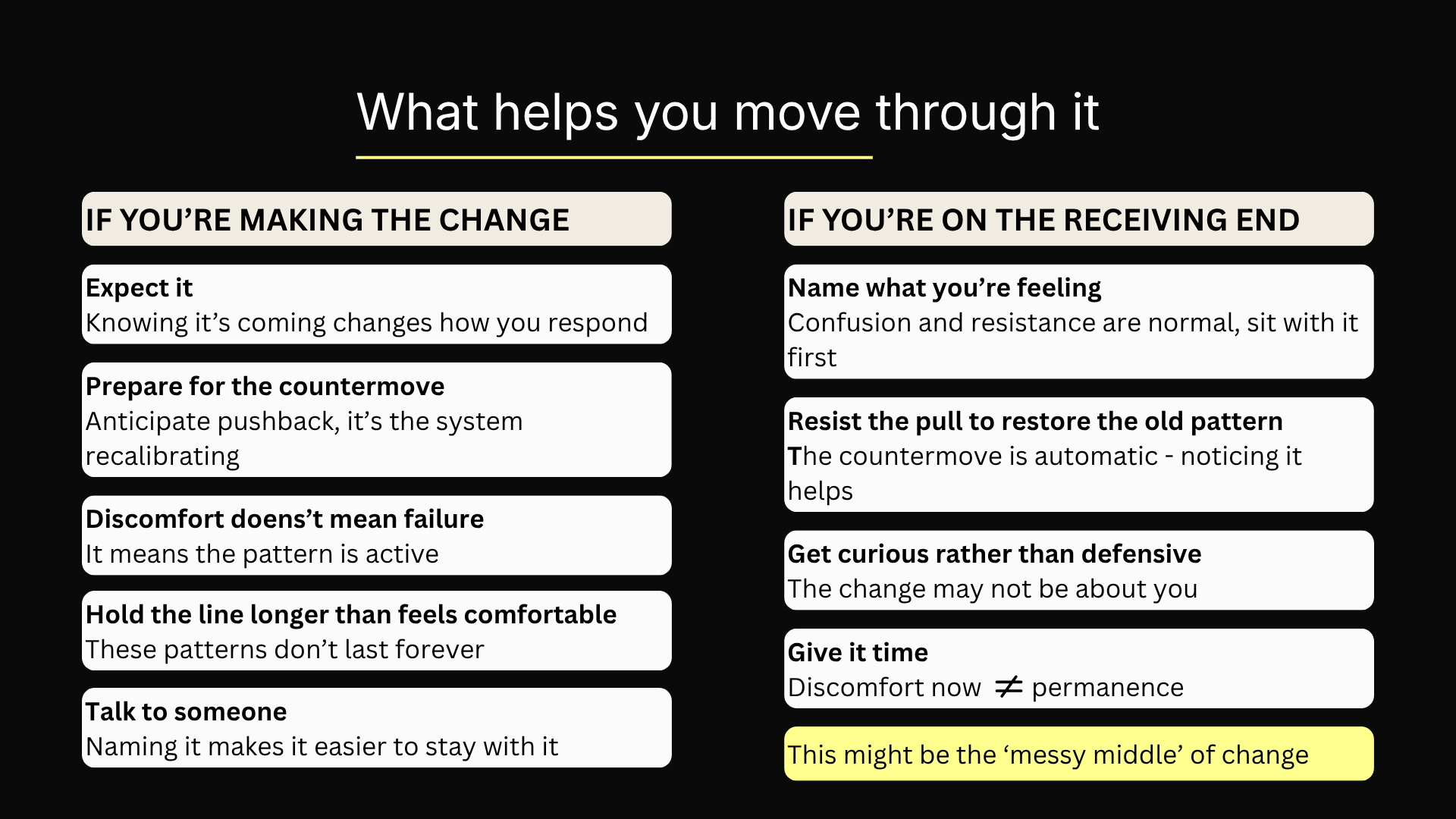
If you’re making the change:
-Expect it. If you know the burst may come, it doesn't feel like a derailment when it arrives.
-Prepare for the countermove. If your change involves others, anticipate pushback. It isn't opposition, it's the system recalibrating.
-Don't interpret discomfort as failure. Discomfort tells you the pattern is active. It doesn't tell you the change is wrong.
-Hold the line longer than feels comfortable. These patterns don't last forever, although they rarely resolve as quickly as we'd like.
-Reduce friction in the new direction. Support the new behaviour practically. Don't rely on willpower alone.
-Talk to someone, perhaps even the people affected. Naming what's happening makes it easier to stay with it, and you might receive support for the change from people around you.
If you're on the receiving end:
-Name what you're feeling. Confusion, frustration, or resistance in response to someone else's change is normal. It doesn't need to be acted on immediately.
-Resist the pull to restore the old pattern. The countermove is automatic. Noticing it is the first step to not being governed by it.
-Get curious rather than defensive. The change isn't necessarily about you, even when it feels that way. You might find you can support the person making it.
-Give it time. A new normal takes time to form. The discomfort of the transition is not the same as the permanence of loss.
Where this leaves you
Change is hard in a very specific way. Not because it’s impossible. But because there’s a point where it asks more of you than you expected, whether you're the one making the change, or the one living alongside it.
The extinction burst is often that point.
Once you recognise it, from either side, your perspective shifts. The next time things feel like they're getting worse before they get better, you have a different interpretation available, and you can intentionally choose the next steps you take.
You're in the part of the process where the old pattern hasn't quite let go yet. It’s the ‘messy middle’ of change.
This is the kind of pattern we help people recognise and move through inside FLUXX.